
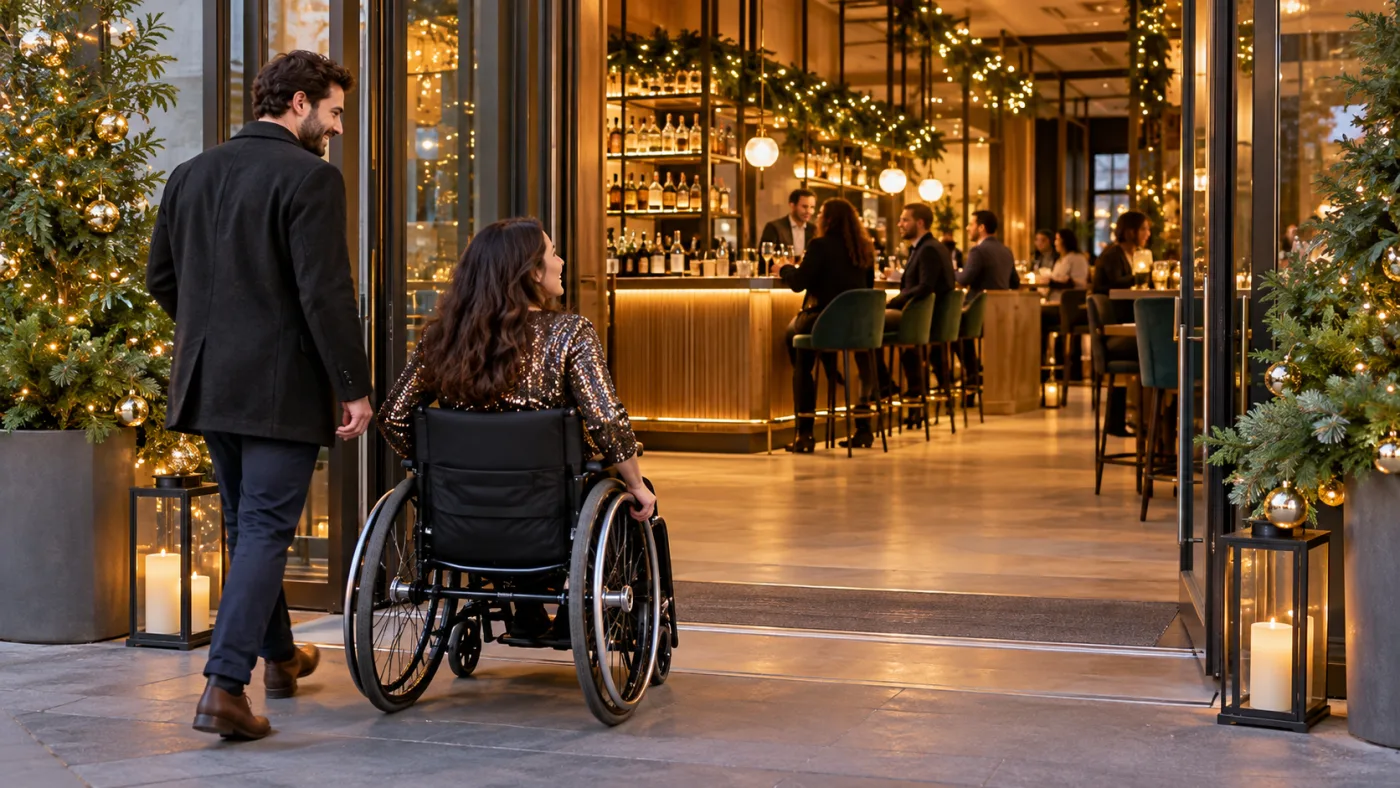

Do not treat “wheelchair accessible” as a complete answer. Confirm the route from curb or transit stop to entrance, the door and threshold, circulation inside, seating, restroom access and the exit plan. Seasonal installations can change an otherwise familiar venue by adding décor, temporary platforms, queues and dense photo areas. Contact the host with specific functional questions, record who answered and recheck near the visit. This guide is a planning framework, not a certification of any venue or legal conclusion about compliance.
Map the complete arrival route
Start before the doorway. Identify the nearest step-free transit exit or parking space, curb cut, surface condition and distance to the actual event entrance. A building may have an accessible main entrance while the pop-up uses a side or rear door. Ask whether queue barriers preserve a clear route and whether staff can prevent a guest from waiting outdoors when weather or disability makes that unsafe. Use current street imagery only as a clue, then confirm with the venue because construction and seasonal layouts change.
Ask precise entrance questions
Replace “Is it accessible?” with measurable questions: Are there steps? Is there a ramp or lift, and where is it? How wide is the narrowest door? Is the threshold raised? Is the door heavy, automatic or staff-assisted? Does the elevator serve every public level included in the ticket? A yes-or-no answer can hide a separate entrance or a platform that requires advance staff support. Specific questions make it easier for an operator to inspect the route and give a useful reply.
Confirm seating and circulation
Ask whether seating is guaranteed, reservable or first come, and whether a wheelchair user can remain with the group without blocking an aisle. High-top-only spaces can be inaccessible even when the entrance is step-free. Dense décor and photo stations may reduce turning space. For timed experiences, clarify whether moving between rooms is required and whether guests can skip a section without losing the route to the exit. Request a practical layout description rather than assuming a promotional floor plan reflects the seasonal setup.
Restrooms and service counters matter
Confirm that an accessible restroom is open during the event, on the same accessible route and not being used for storage. Ask whether the bar or host stand has a lowered service point and whether table service is available when the counter is too high or crowded. If medication, refrigeration or a companion restroom matters, state the specific need. Do not rely on a general building listing when the seasonal operator controls only part of the property.
Worked example: a multi-level pop-up
A venue advertises three decorated floors and says the building has an elevator. A guest asks whether the elevator reaches every ticketed area, whether queues form inside it and whether an accessible restroom is available on an elevator-served floor. The operator explains that one photo room is reached only by stairs but the main bar, dining room and restroom are accessible. The group can now judge the tradeoff before paying. The useful answer is not a perfect label; it is a clear description of what will and will not be available.
Include sensory and communication needs
Christmas bars can combine flashing lights, loud music, artificial snow, fragrance, crowd noise and performers. Ask about quieter arrival periods, strobe effects, fog, volume changes and the possibility of waiting in a less crowded area. Guests who lip-read may need better lighting at check-in. A written menu and text-based ticket confirmation can help with communication. These conditions vary by hour, so a venue may offer a workable early session even when its late-night format is not suitable.
Make a backup and exit plan
Save the venue contact, ticket terms and route before leaving. Identify a nearby accessible alternative or a simple way to end the night if equipment fails, the layout differs from the description or crowding becomes unsafe. Confirm that transportation for the return trip can accommodate the group and any mobility device. A backup is not pessimism; seasonal events are temporary operations with more variables than a familiar everyday venue.
Our recommendation
Choose the venue that provides specific, current answers and a workable end-to-end route, even if another option has more dramatic décor. Ask functional questions in writing when possible and avoid buying nonrefundable tickets while essential access details remain unknown. Public accessibility statements and legal standards are important starting points, but individual planning still requires the current event layout. Report material discrepancies through the venue and our corrections channel so the next visitor receives clearer information.
Sources and review notes
Sources were reviewed on October 22, 2026. External event details can change; use the linked operator or venue for transactions.